
AI in digital marketing: what actually works right now
Where AI genuinely saves marketers time on real client work, and where it quietly makes things worse.
Read article →
This digital marketing roadmap takes you from zero to your first job or client in 9 stages. Each stage tells you what to learn, which free tool to practise on, and one small project to finish before you move on. It works whether you study alone for free or learn with a trainer.

Digital marketing is getting a business in front of the right people online, then turning their attention into enquiries and sales. It happens on Google, Instagram, YouTube, WhatsApp, email and the business's own website.
Think of a shop on a busy road. SEO is the signboard people see when they search. Social media and content are the chats at the counter. Ads are paid flyers. Analytics is the register that shows what sold.
Who hires? Agencies, brands, startups, schools, clinics and local shops that want more leads. Many digital marketers also freelance.
A normal day might mean planning posts, designing a creative, editing a reel, checking which ads brought leads and sending a client a short report.
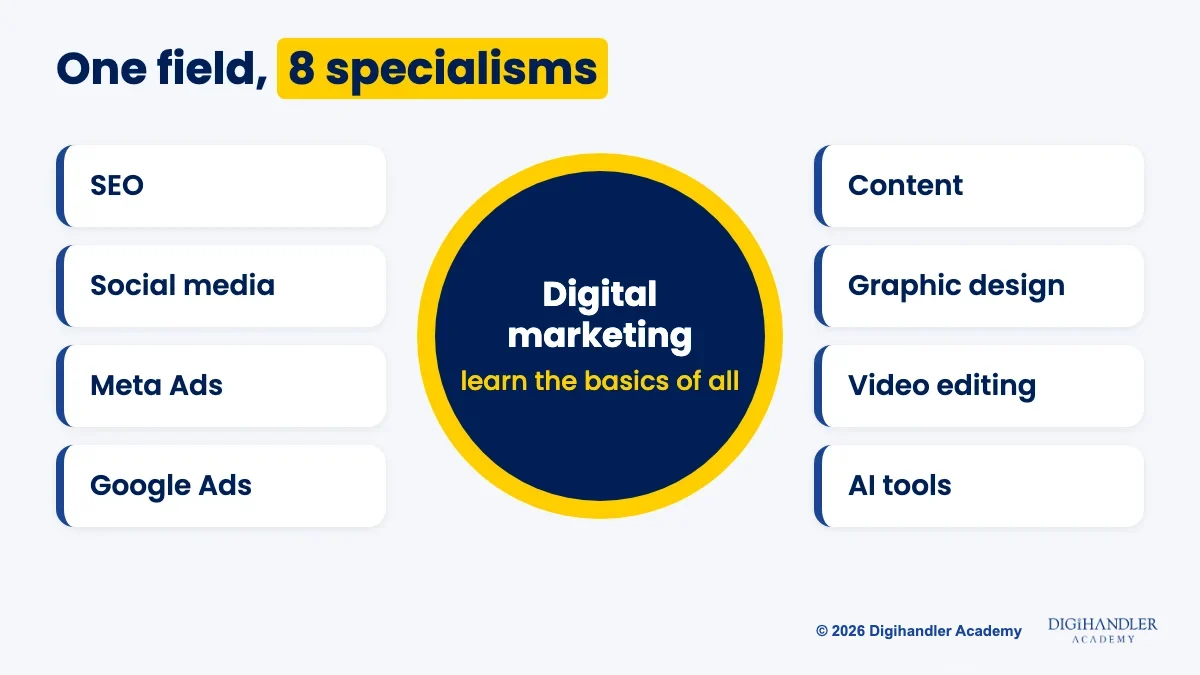
The field splits into eight specialisms: SEO, social media, Meta Ads, Google Ads, content, graphic design, video editing and AI tools. This roadmap teaches the basics of all eight, then helps you go deep in one.
Here is the full path. The weeks assume 1 to 2 hours of study a day, which adds up to roughly six months. Treat them as a guide, not a promise. Some stages will click faster, some slower.
Every stage ends with a mini-project. Do not skip it: the project turns watching into skill and later becomes your portfolio.
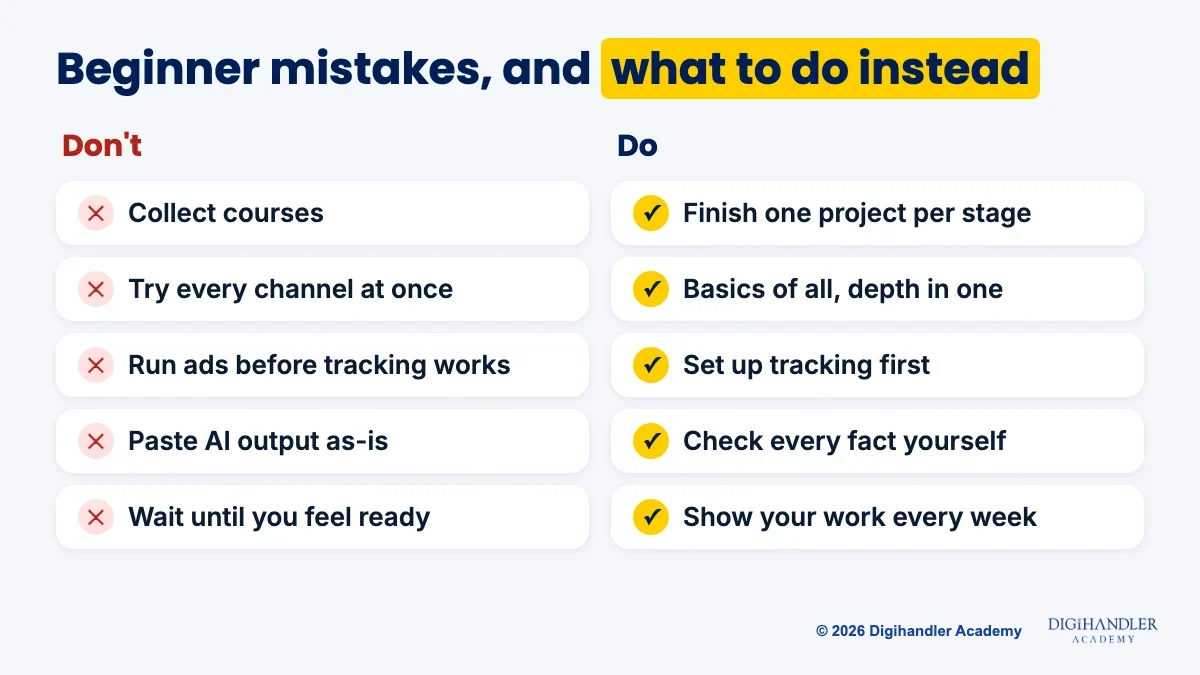
Stage 1, foundations. Learn the marketing funnel (awareness, interest, decision, action), buyer personas, and organic (free) versus paid reach. Practise with the free version of ChatGPT, Claude or Gemini: ask it to quiz you, not to do the work. Mini-project: a one-page marketing plan for a real local business, such as a café near you.
Stage 2, content and copywriting. Every channel runs on words: captions, ad headlines, blog posts, emails. Learn to write a hook, one clear benefit and one call to action. Practise in Google Docs. Mini-project: 10 captions and one 600-word blog post for the same business. The content marketing roadmap goes deeper.
Stage 3, graphic design. You do not need to draw. Learn layout, contrast, fonts and brand colours, then build designs on Canva's free plan. Mini-project: six Instagram posts that clearly belong to one brand. The graphic design roadmap has the full path.
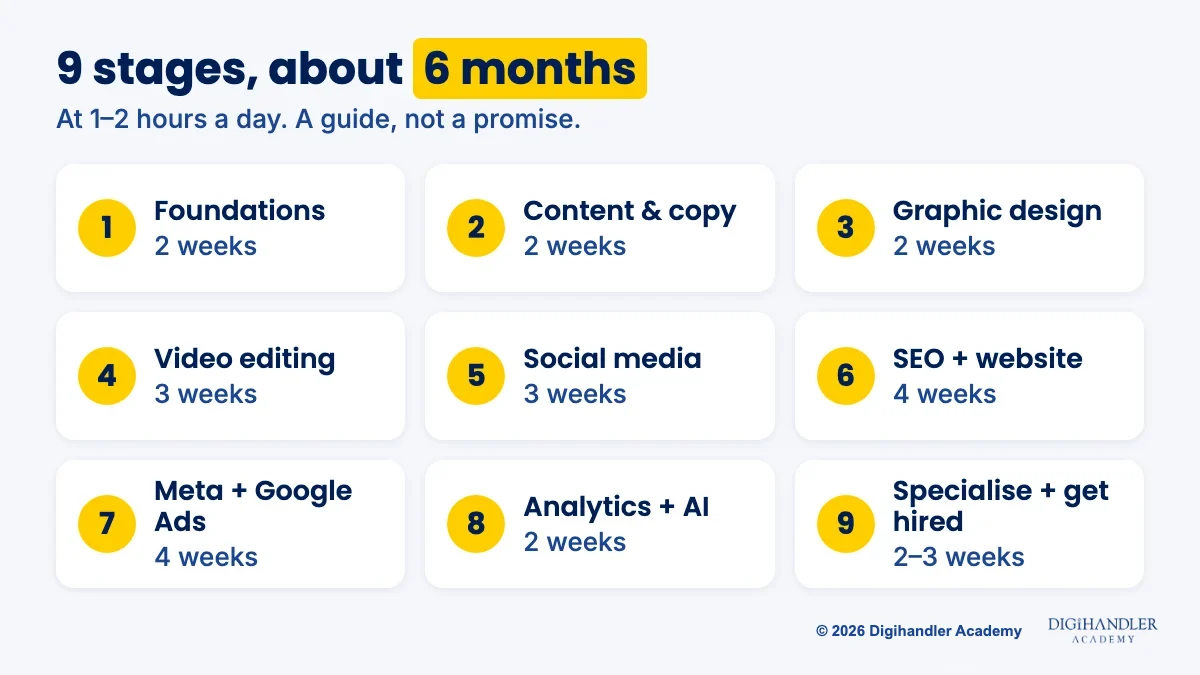
Stage 4, video editing. Learn cuts, pacing, captions and a strong first two seconds. Practise on Edits, Instagram's free editing app, on your phone, or on the free version of DaVinci Resolve on a laptop. Mini-project: three reels of 20 to 40 seconds. Follow the video editing roadmap for more.
Stage 5, social media marketing. Now combine stages 2 to 4. Learn content pillars, a posting calendar, reading insights and replying to comments. Practise with a free Instagram professional account and Meta Business Suite. Mini-project: run one page for 30 days and write down what worked. The social media marketing roadmap has the detail.
Stage 6, SEO and a simple website. Learn how Google finds and ranks pages, keyword research, page titles, and local SEO through a Google Business Profile. Practise with Google Search Console and Google's free SEO Starter Guide. Mini-project: publish a three-page website, connect Search Console, and improve one Google Business Profile with the owner's permission. The SEO roadmap covers it step by step.
Stage 7, paid ads. Meta Ads create demand: they show a product to people who were not looking for it. Google Ads capture demand: they appear when someone is already searching. Learn objectives, audiences, keywords, budgets and conversion tracking. Practise inside Meta Ads Manager and Google Keyword Planner. Mini-project: a full campaign plan for each platform, and if you can, a small test on a budget you can afford to lose. Use the Meta Ads roadmap and the Google Ads roadmap.
Stage 8, analytics and AI. Learn to read Google Analytics 4: users, traffic sources and conversions. Google gives anyone with a Google account a demo account with real data from its merchandise store. Then use AI for research, first drafts and reports, and check every fact yourself. Mini-project: a one-page monthly report from the demo account. The AI tools roadmap shows which tool fits which job.
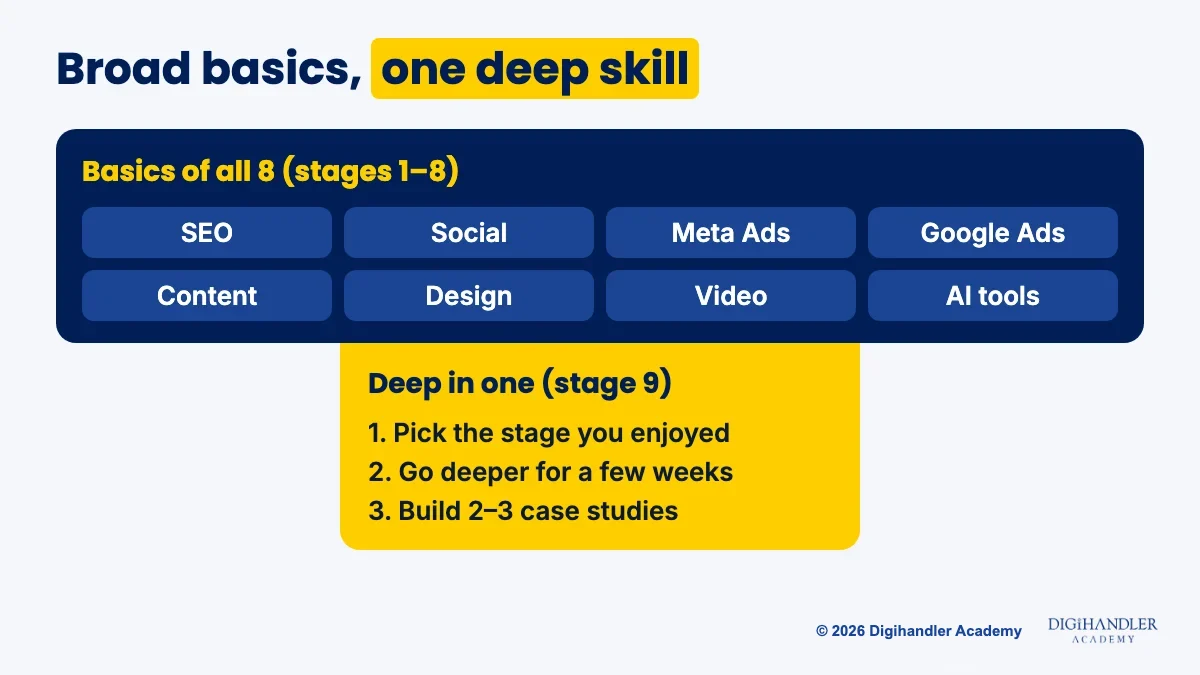
Stage 9, specialise and get hired. Employers want someone who knows a little of everything and a lot of one thing. Pick the stage you enjoyed most and go deeper for a few weeks. Mini-project: a portfolio, an updated LinkedIn profile, and 10 internship applications or pitches to local businesses.
If you would rather have this whole path taught in order, with a trainer checking each project, that is exactly what our digital marketing course does.
Start free. Pay only when a client or employer needs a paid tool.
A portfolio is proof. Three to five finished projects beat ten certificates. For each one, show the goal, what you did and the result, even if the result was small.
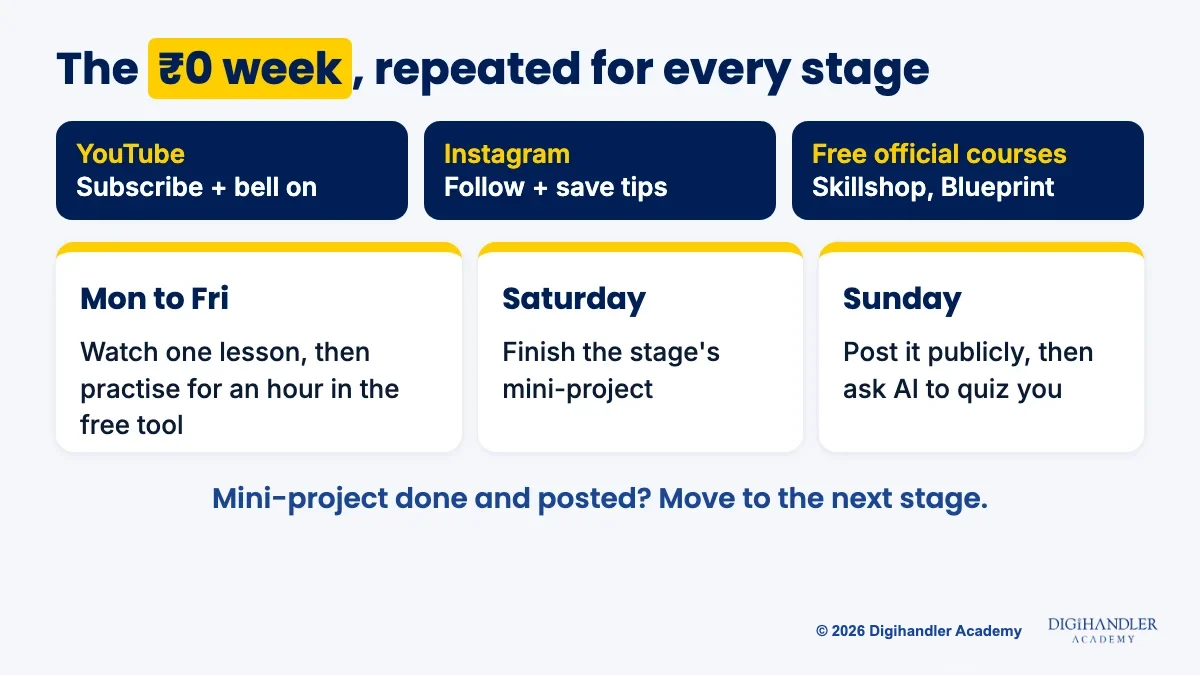
No budget? You can follow every stage above for ₹0. Set it up once, then repeat the same week until each stage is done.
Self-study works, but it is slow in one way: nobody tells you what you got wrong, so you move on with the mistake still in it.
Our course follows this same path across 44 modules: 5 months of practical learning, then 1 month of professional training. Lovish Madaan, our founder, still runs client campaigns every week and teaches from those accounts. A trainer checks your work, you practise on live client projects, and you learn with a batch on a fixed weekly schedule.
You also get internship experience, placement assistance (portfolio, resume, LinkedIn and mock interviews) and a certificate of achievement from an ISO 9001 certified academy, plus preparation for official Google certifications. We have trained 300+ students in three years. We do not promise jobs, because the offer depends on your interview, but you will have real work to show.
Join at our Rohtak campus or in a live online batch. Before you pay anything, sit in on 3 days of free demo classes. Fees depend on the track and batch and are shared on a call. See the full syllabus on the digital marketing course page.
Riya writes Digihandler Academy's guides and roadmaps. Every article is fact-checked and reviewed by Lovish Madaan, founder & trainer, who has run the Digihandler agency since 2018. More from Riya →
Studying 1 to 2 hours a day, most beginners can cover the basics of all eight specialisms in about six months: foundations, content, design, video, social media, SEO, paid ads, and analytics with AI tools. That is a guide, not a promise. Some people move faster, and some need longer on a stage like SEO or ads. What matters more than speed is finishing a mini-project at every stage, because those projects become the portfolio that gets you hired or wins your first client.
Yes, many people do. Some companies list a degree in their job posts, but most employers and clients in digital marketing look first at what you can show: live websites, social media pages you have grown, ad campaigns you have planned or run, and reports you have written. A portfolio of three to five real projects is the strongest proof you can offer. If you are still in college, you can build that portfolio alongside your studies and apply for internships before you graduate.
Yes. Every stage of this roadmap can be practised with free tools such as Canva, Google Search Console, Google Analytics 4 and its demo account, and Meta Business Suite. Free training is available from Google Skillshop, Meta Blueprint, Google's SEO Starter Guide and HubSpot Academy. Digihandler Academy also shares free lessons and tips on its YouTube channel and Instagram. The only thing that costs money is running real ads, and you can learn most of that by planning campaigns before you spend anything.
Start with the foundations: how the marketing funnel works, who the audience is, and the difference between organic and paid reach. Then learn content writing, because every channel runs on words. After that, add design and short video so you can make your own creatives. Once you have the basics of all eight specialisms, pick the one you enjoyed most, such as SEO, Meta Ads or video editing, and go deeper. Broad basics plus one strong skill is what employers look for.
No. Most digital marketing work happens inside tools with buttons and menus: Canva, Meta Ads Manager, Google Ads, Google Analytics and WordPress. You never have to write code to plan content, run ads or improve a page for SEO. A little technical comfort helps, such as copying a tracking code into a website setting or reading a simple report, but every tool has step-by-step help guides. If you can use ChatGPT and a spreadsheet, you can learn digital marketing.
Where AI genuinely saves marketers time on real client work, and where it quietly makes things worse.
Read article →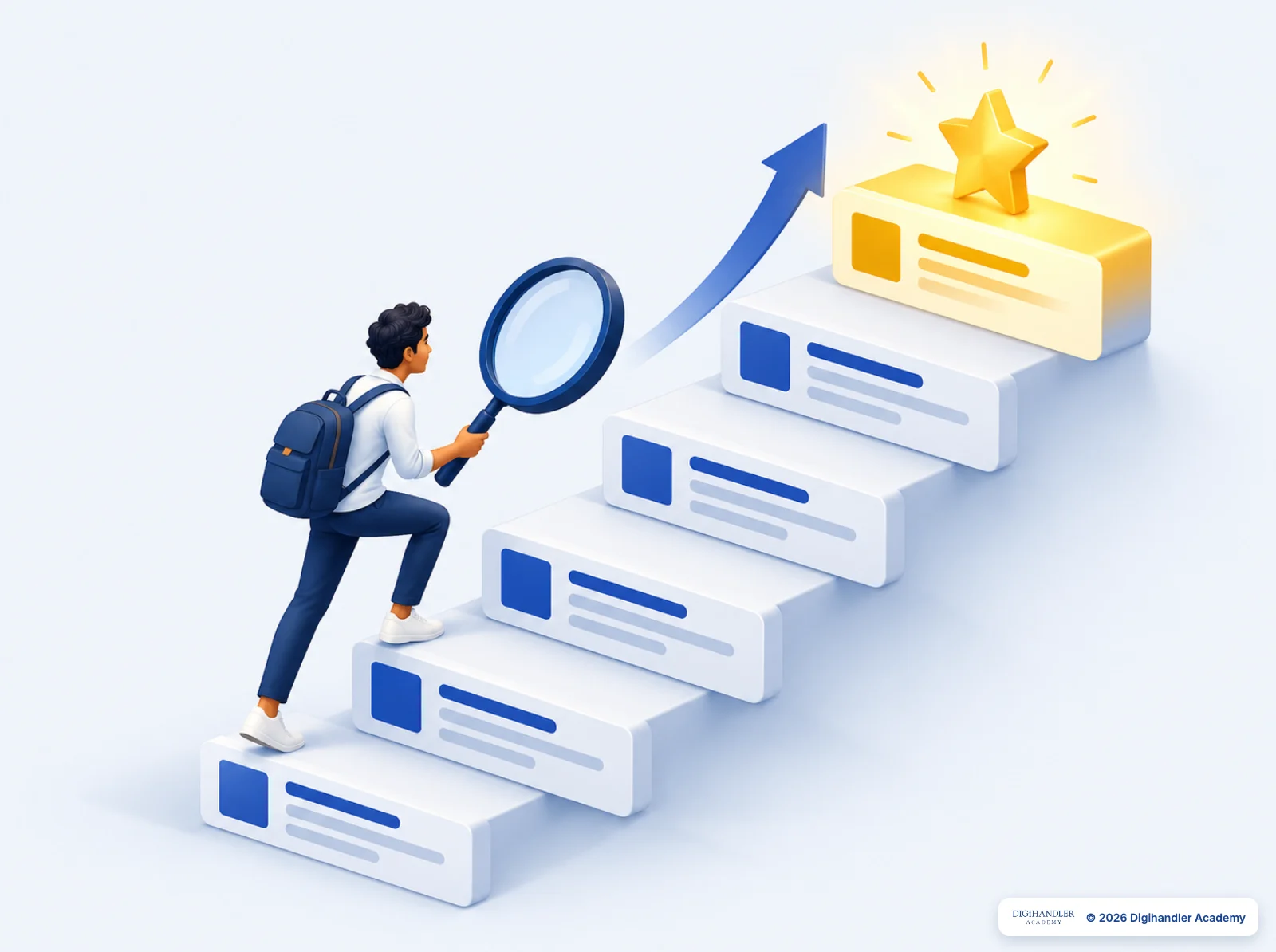
What decides whether an AI assistant quotes your page, and the fixes worth doing first.
Read article →