
AI in digital marketing: what actually works right now
Where AI genuinely saves marketers time on real client work, and where it quietly makes things worse.
Read article →
This content marketing roadmap takes you from never having written for a business to having a portfolio a client can say yes to. It is split into 8 stages. Each stage has one thing to learn, one free tool, and one small project to finish before you move on.

A content marketer helps a business get noticed and trusted by publishing useful things: blog posts, reels, YouTube videos, emails and newsletters. The goal is not just to write. It is to bring the right people in and move them one step closer to buying.
Think of it like a good shopkeeper who answers questions honestly. People come back because they got help, not because they saw an ad.
Agencies, D2C brands, coaching institutes, SaaS companies and local businesses all hire for this. A normal day looks like: read what customers are asking, plan the week's posts, write a blog or a reel script, send a newsletter, then check what worked. Content is one part of the bigger picture in our digital marketing roadmap.
Study 1–2 hours a day and the whole path takes roughly 4–5 months. Treat the weeks below as a guide, not a promise. Do not skip the mini-projects. They become your portfolio.
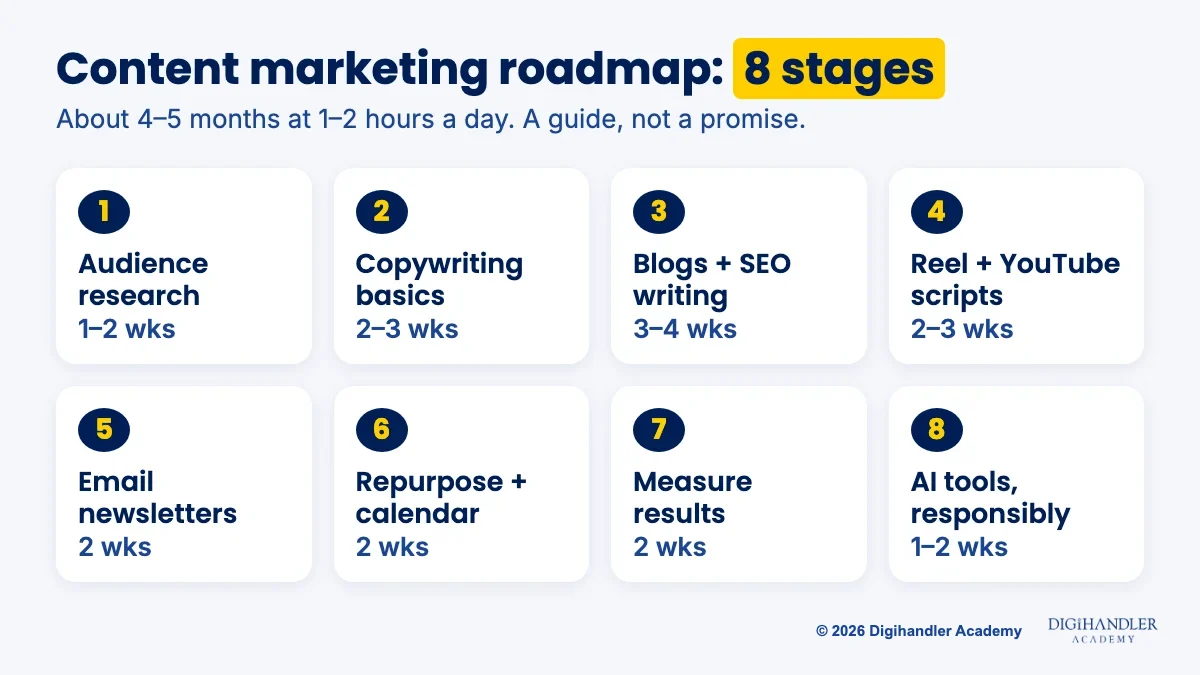
Stage 1 is audience research. Pick one type of business, say a local gym. Type its topics into Google and note the 'People also ask' questions. Read Reddit and Quora threads. Check Google Trends to see what people search for more over time. Mini-project: a one-page reader profile with 20 real questions they ask.
Stage 2 is copywriting basics. Copy is writing that makes someone do something: read on, click, reply or buy. Learn three things first: a headline that promises a clear benefit, an opening line that hooks, and one call to action per piece. A simple formula is Problem, Agitate, Solve: name the pain, show why it matters, then offer the fix.
Practise in Google Docs. Mini-project: rewrite 10 headlines and 3 product descriptions from real websites, keeping the before and after side by side.
Stage 3 is blogs and SEO writing. A keyword is just a question someone typed into Google. Search it first and look at what ranks. Then write a clearer, more useful answer, with the direct answer near the top, short headings and links to your other posts. Google's own SEO Starter Guide is free and worth reading once. Our SEO roadmap goes deeper on keywords.
Publish on a free blog and connect Google Search Console, which is free, so you can see which searches show your page. Mini-project: two published posts, each answering one real question from your Stage 1 list.
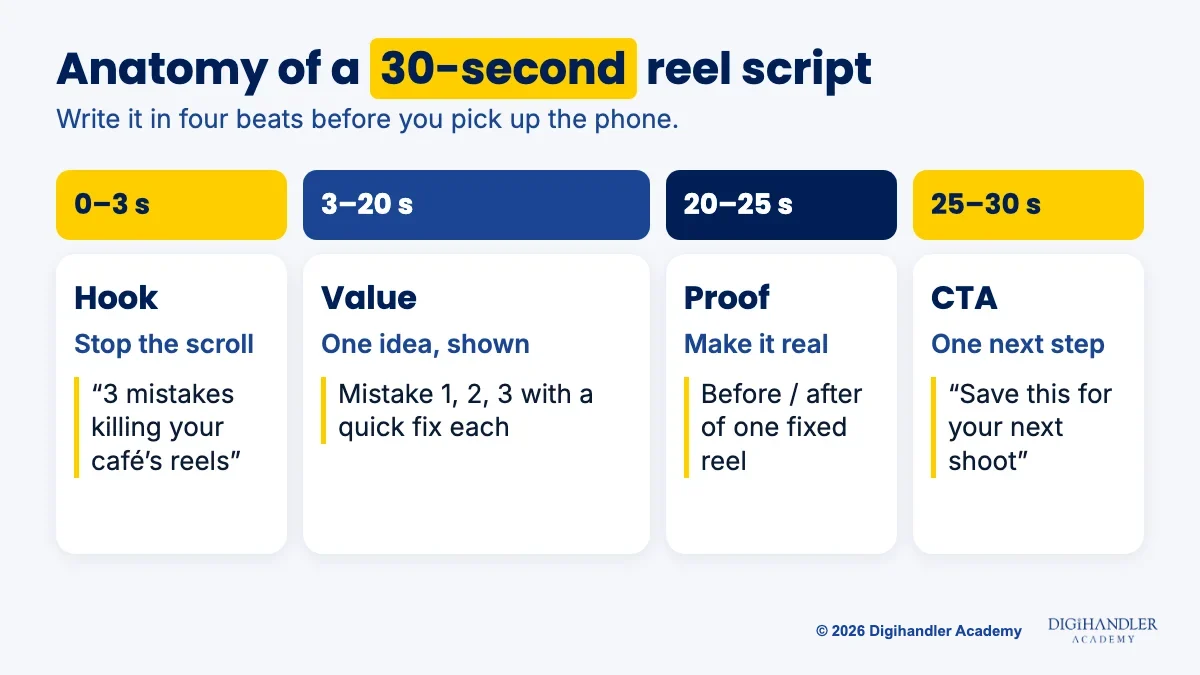
Stage 4 is scripts for reels and YouTube. Short videos are written in beats: a hook in the first seconds, one idea, a quick proof, and one next step. YouTube scripts follow the same idea, just longer. Read each script out loud and cut any line you stumble on. Mini-project: three reel scripts plus one 5-minute YouTube script, and film one on your phone. When you want to cut it well, the video editing roadmap picks up from here.
Stage 5 is email. Social platforms decide who sees your post. An email list belongs to you. Learn to write a subject line that earns the open, one main idea per email, and a single link to click.
beehiiv has a free plan for up to 2,500 subscribers, which is plenty to practise on. Mini-project: a welcome email plus four weekly issues on your chosen topic, sent to friends or classmates who agree to read them.
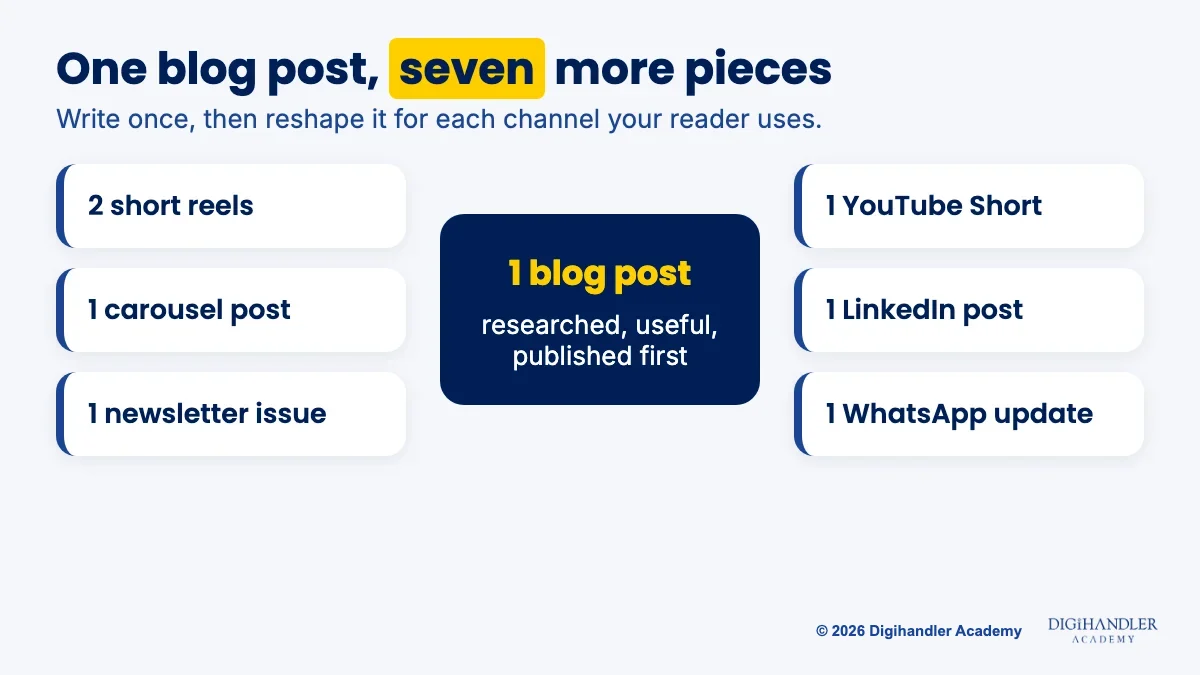
Stage 6 is repurposing. Cooking one big pot of dal and serving it across three meals saves time. Content works the same way. One researched blog post can become reels, a carousel, a newsletter issue and a LinkedIn post.
A content calendar is just a table of what goes out, where and when. Make one in Google Sheets with columns for date, channel, topic, format, status and link. Mini-project: a 4-week calendar built from one blog post, with every piece drafted.
Stage 7 is measuring. Pick the number that matches the goal. For blogs, check clicks and search queries in Search Console and visits in Google Analytics 4, both free. For reels, check reach, watch time and saves in the app's insights. For email, check opens and clicks.
Then ask one question: what will I do differently next week? Mini-project: a one-page monthly report for your own content, ending with three next steps.
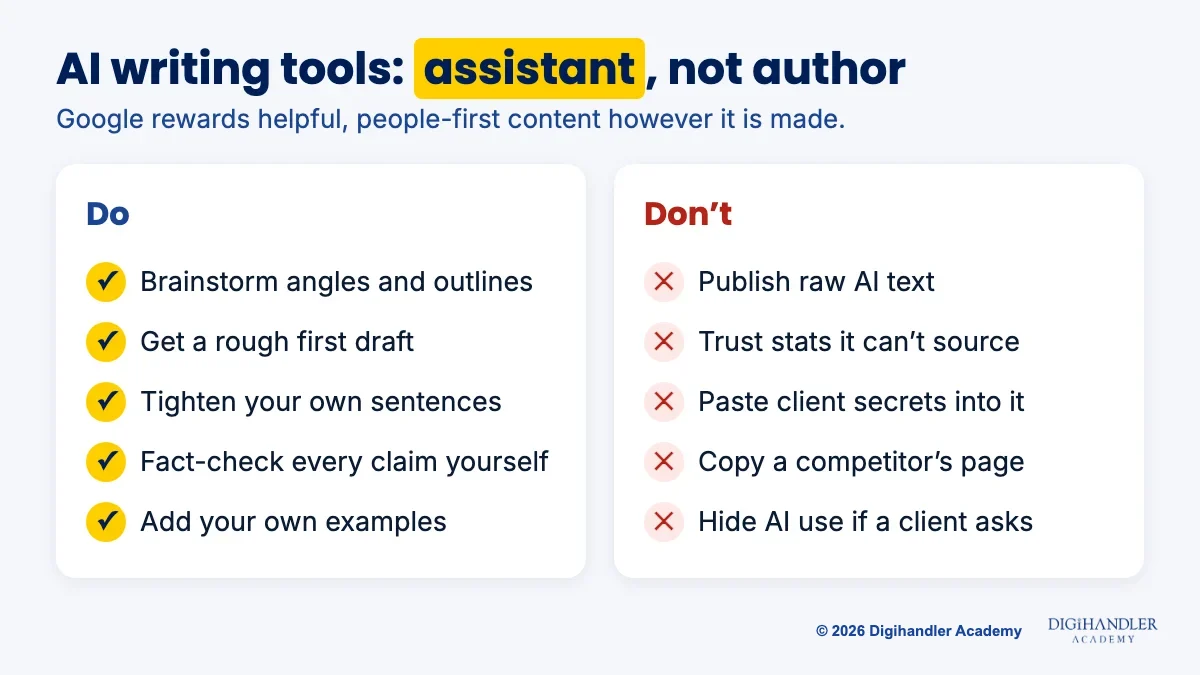
Stage 8 is AI, used responsibly. ChatGPT, Claude and Gemini are great at brainstorming angles, outlining and tightening your sentences. They also make up facts with total confidence. Treat AI as a fast assistant, never the author.
Google says it rewards original, helpful, people-first content however it is produced, and that using automation mainly to game rankings breaks its spam policies. So check every fact, add your own examples, never paste a client's private data into a chatbot, and be honest if a client asks how you work. Mini-project: write one article with AI help and keep a short note of what you changed and why.
Clients do not ask for certificates first. They ask to see work. Put these five projects in one Google Drive folder or a simple portfolio page:
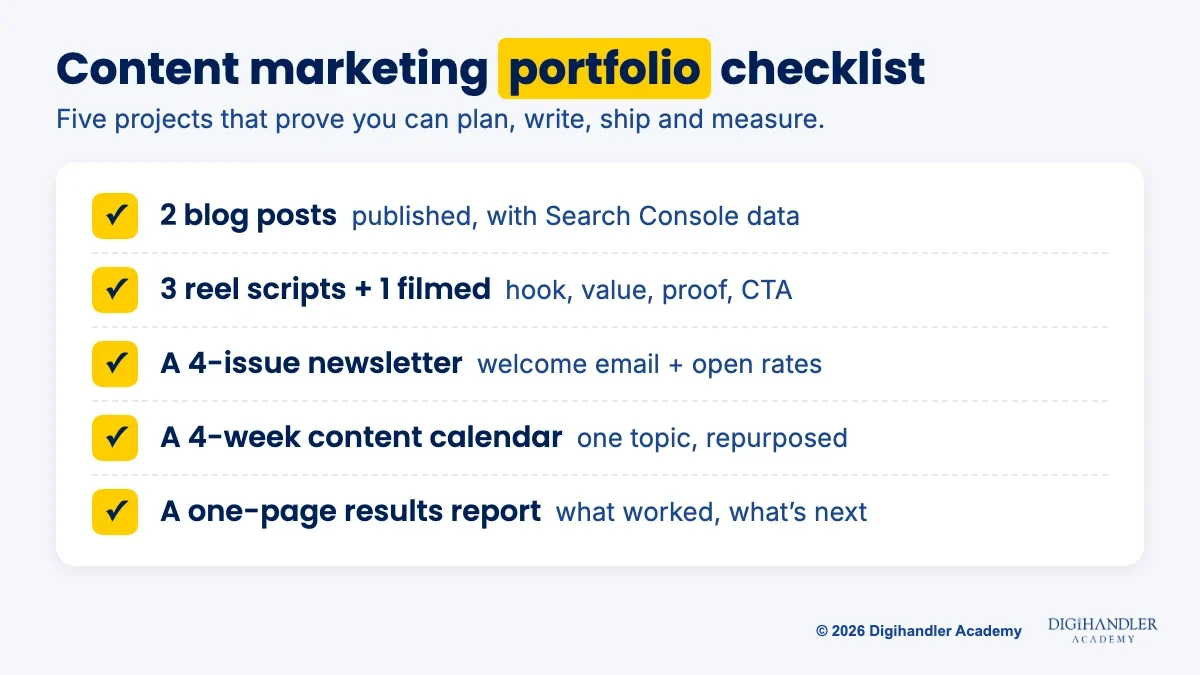
You can follow this whole roadmap without spending a rupee. Here is the routine:
Self-study works, but it is slow and lonely. Nobody tells you why your headline is weak or your blog is not ranking. That gap is what a structured course fills.
Our content marketing module covers content strategy and audience research, copywriting for conversions, blog and SEO writing, email and WhatsApp content, repurposing, AI-assisted workflows and content analytics. It sits inside a 44-module, 6-month programme: 5 months of practical learning and 1 month of professional training.
You get a trainer checking your work, real client projects, a fixed weekly schedule and a batch to learn with. Internship experience and placement assistance are included, along with resume and mock-interview prep, and a certificate from our ISO 9001 certified academy. We have trained 300+ students so far. Placement assistance means real help; the job offer still depends on your interview.
Learn at our Rohtak campus or in a live online batch. Start with the 3-day free demo and sit in on real classes before you pay anything. Fees depend on the track and batch, and we share them on a call. See the content marketing course or book your demo.

Riya writes Digihandler Academy's guides and roadmaps. Every article is fact-checked and reviewed by Lovish Madaan, founder & trainer, who has run the Digihandler agency since 2018. More from Riya →
Most beginners who study 1–2 hours a day can follow a complete content marketing roadmap in about 4–5 months. That covers audience research, copywriting, blogs and SEO writing, reel and YouTube scripts, email newsletters, repurposing, measuring results and AI tools. The time varies with how much you practise. Reading about content does not build the skill; publishing does. Finish one small project at every stage, such as two live blog posts or a four-issue newsletter, and by the end you will have a portfolio rather than just notes.
Content writing is producing the words: a blog post, a caption, an email. Content marketing is the whole system around those words. It includes researching the audience, choosing topics that match a business goal, planning a calendar, distributing each piece on the right channels, repurposing it, and measuring whether it brought visitors, leads or sales. A content writer can be excellent at sentences. A content marketer also decides what to write, where it goes and whether it worked. Most people start as writers and grow into the marketing side.
No degree is required to become a content marketer. Clients and employers mostly judge you on a portfolio of real work: published blog posts, scripts, newsletters and a short results report. Clear, simple English matters more than fancy vocabulary, and simple writing is usually better content anyway. Many brands in India also need content in Hindi or Hinglish, so writing well in your own language is a real advantage. Free tools like Google Docs' spelling and grammar check help you clean up drafts while you improve.
Yes. You can learn content marketing for free by following a structured roadmap and practising every week. Use free tools: Google Docs for writing, Google Trends for research, Google Sheets for a content calendar, Search Console and Google Analytics 4 for measuring, and beehiiv's free plan for a newsletter. HubSpot Academy offers a free Content Marketing Certification course, and Google publishes free guides on helpful content and SEO. Digihandler Academy also shares free lessons and tips on its YouTube channel and Instagram page.
Yes, if you use AI as an assistant and not as the author. AI tools like ChatGPT, Claude and Gemini are useful for brainstorming topics, outlining and tightening sentences. They can also invent facts, so check every claim before publishing. Google has said it rewards original, helpful content however it is produced, but using automation mainly to manipulate rankings breaks its spam policies. Add your own examples and experience, keep client data out of chatbots, and be honest with clients about how you use AI.
Where AI genuinely saves marketers time on real client work, and where it quietly makes things worse.
Read article →
What decides whether an AI assistant quotes your page, and the fixes worth doing first.
Read article →