AI in digital marketing: what actually works right now
Where AI genuinely saves marketers time on real client work, and where it quietly makes things worse.
Read article →
A part time digital marketing course can fit around a full-time job or a college timetable, but only if you plan the hours honestly. This guide covers weekday versus weekend batches, live versus recorded classes, a real weekly schedule, what to do in a bad week, and what you can fairly expect at the end.

Yes. Many people learn digital marketing while they keep a job or attend college. The skill is practical, so it suits evenings and weekends. You learn a tool, try it on a real task, and come back with questions.
The catch is time. A part time digital marketing course is not a few videos on a Sunday. Think of it like learning to drive. Watching someone drive teaches you a little. Driving yourself, a few hours every week, is what makes you a driver.
If you are thinking about a full career change, read our guide on switching careers into digital marketing first. It covers which of your old skills carry over and how to plan the money side.
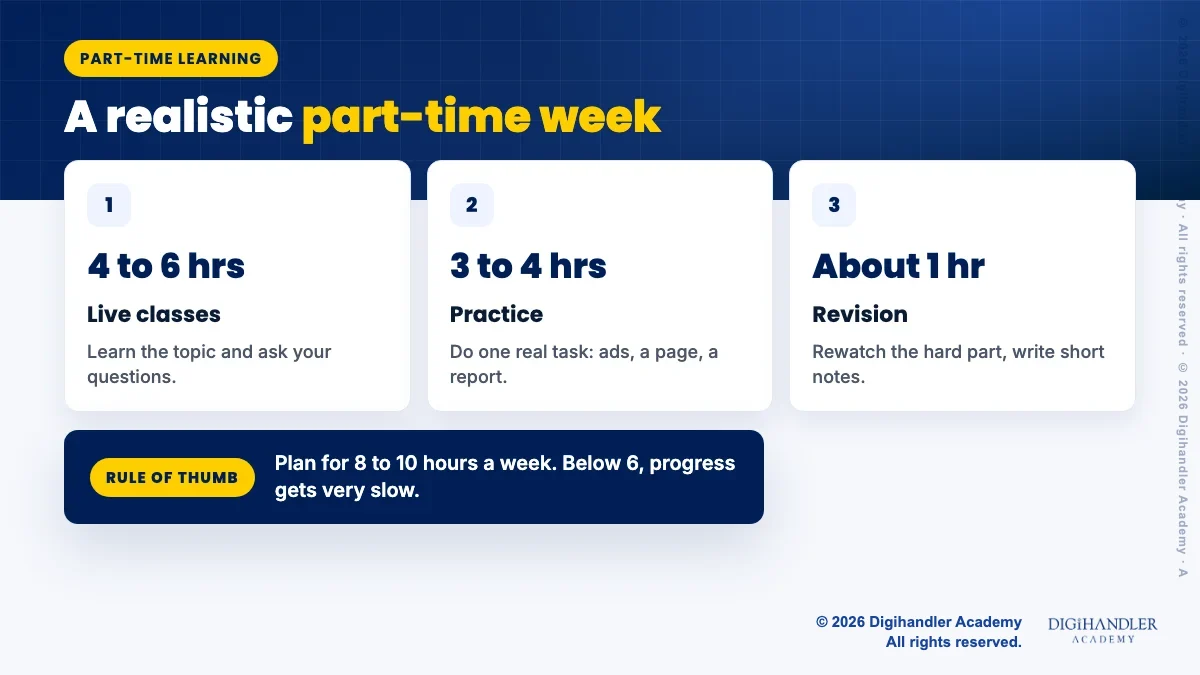
Plan for about 8 to 10 hours a week. This is a working rule of thumb, not a survey number. Roughly half goes to live classes. The other half goes to practice and revision.
Practice is the part people skip, and it is the part that matters most. Writing three ad headlines, fixing one slow web page or reading one report teaches more than an extra hour of watching.
Below 6 hours a week, progress gets very slow. You spend each class remembering the last one. Above 12 hours, most working people burn out by the second month. Pick a number you can keep for six months, not one you can keep for two weeks.
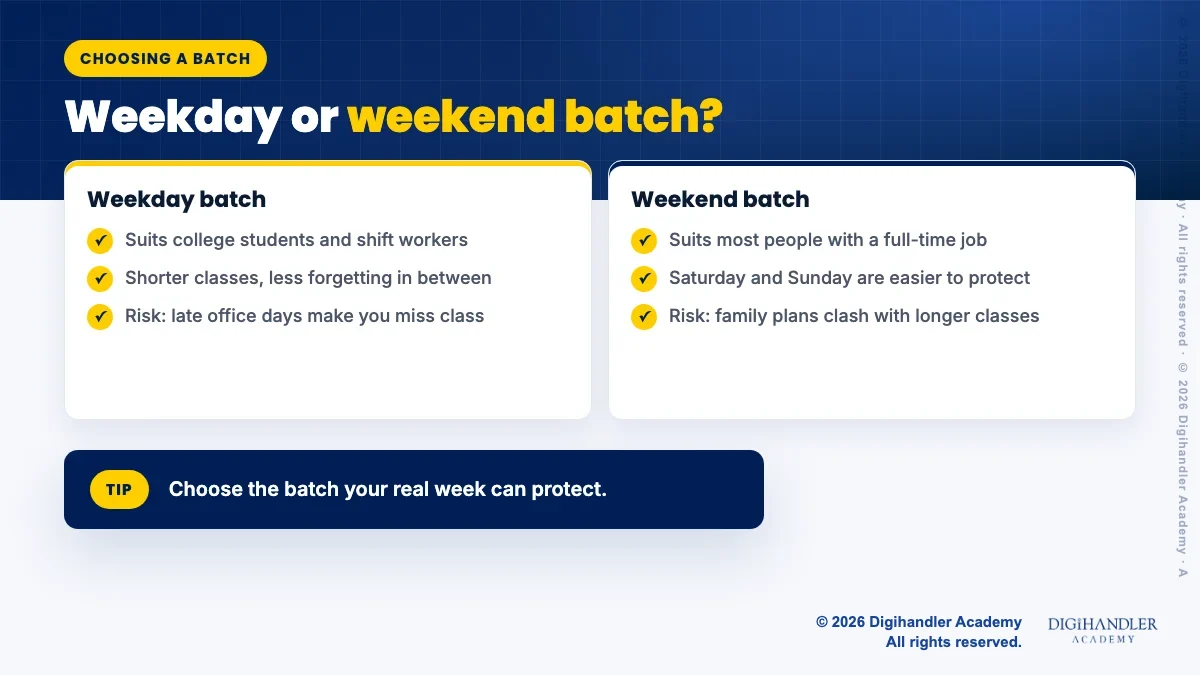
A weekend digital marketing course suits most people with a full-time job. Weekday evenings get eaten by late meetings, travel and family work. Saturday and Sunday are easier to protect.
Weekday batches suit college students and people with shift work or free mornings. Shorter classes spread over the week also mean you forget less between them.
Be honest about your own week. If your office often keeps you late, a 7 pm weekday class will slip again and again. If your weekends belong to family, a weekday batch with recordings may work better.
Recorded videos look flexible, and they are good for learning what the buttons do. The problem is that nobody notices if you stop. Most busy people drift by week three, because nothing pulls them back.
Live classes give you a fixed time, a trainer who answers your question about your own work, and classmates who expect to see you. The best setup for working people is usually live classes with recordings as a safety net for the week you miss.
If you plan to self-study first, our guide on how to learn digital marketing online lays out a free path. For a fuller comparison of formats, see online vs offline digital marketing courses.
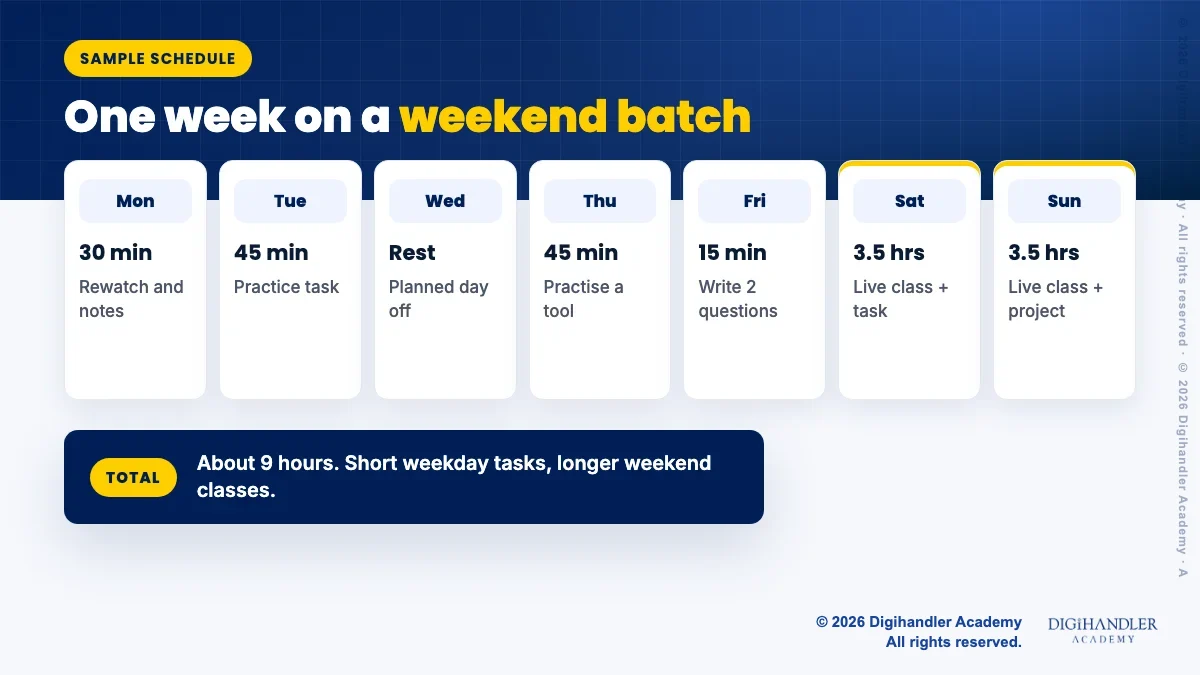
Here is one week for someone working 10 to 7 on weekdays with a weekend batch. It adds up to about 9 hours. Move the pieces to fit your own job.
Every part-time learner has bad weeks: a product launch, exams, a wedding in the family. The goal is not a perfect record. The goal is to never fall more than one week behind.
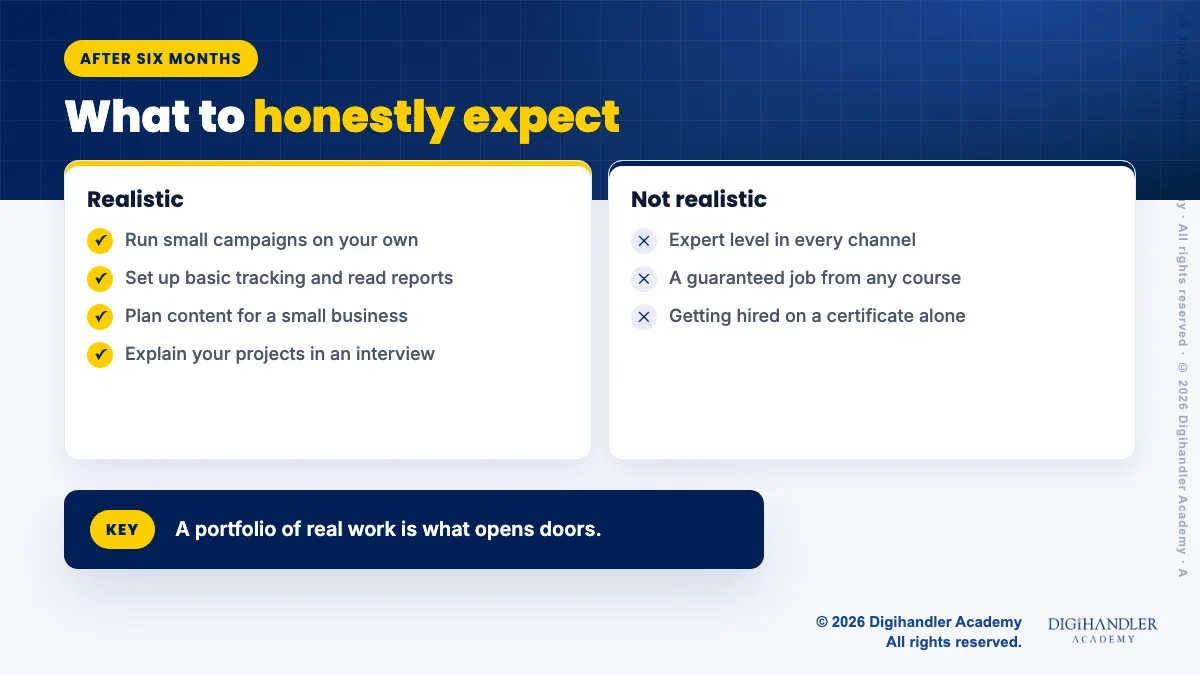
Be realistic. After about six months of steady part-time work, most people can run small campaigns, set up basic tracking, plan content and talk through their own projects in an interview. That is a good starting point, not an expert level.
What gets you a first role or client is proof: a portfolio of real work, a clear resume and practice explaining your results. A certificate helps, but interviewers look at what you actually did. Reels and short videos are a strong portfolio piece too, and our guide on editing reels that people watch shows you how to start.
Nobody can promise you a job, including us. The offer depends on your interview, your portfolio and the market in your city. Any institute that guarantees a job is promising something it does not control.
Ask these on the phone and listen for a specific answer, not a reassuring one. They apply to every digital marketing course for working professionals, including ours.
Since we suggest you judge every institute by the list above, here is how our own course answers it, using only what our course pages say. Online students join the same live batches as our Rohtak classroom, with the same trainers. You can choose a weekday or a weekend batch.
Every class, note and test is recorded in the student app, so a missed session can be caught up. From around the third month, students work on live client projects with real ad accounts and real websites. The programme runs six months: five months of practical learning and one month of professional training.
Placement assistance means portfolio review, resume and LinkedIn work, mock interviews and referrals. It is not a guaranteed job. Fees are the same online and in the classroom and are shared on a call, and there are 3 days of free demo classes before you pay. Details are on the digital marketing course page.
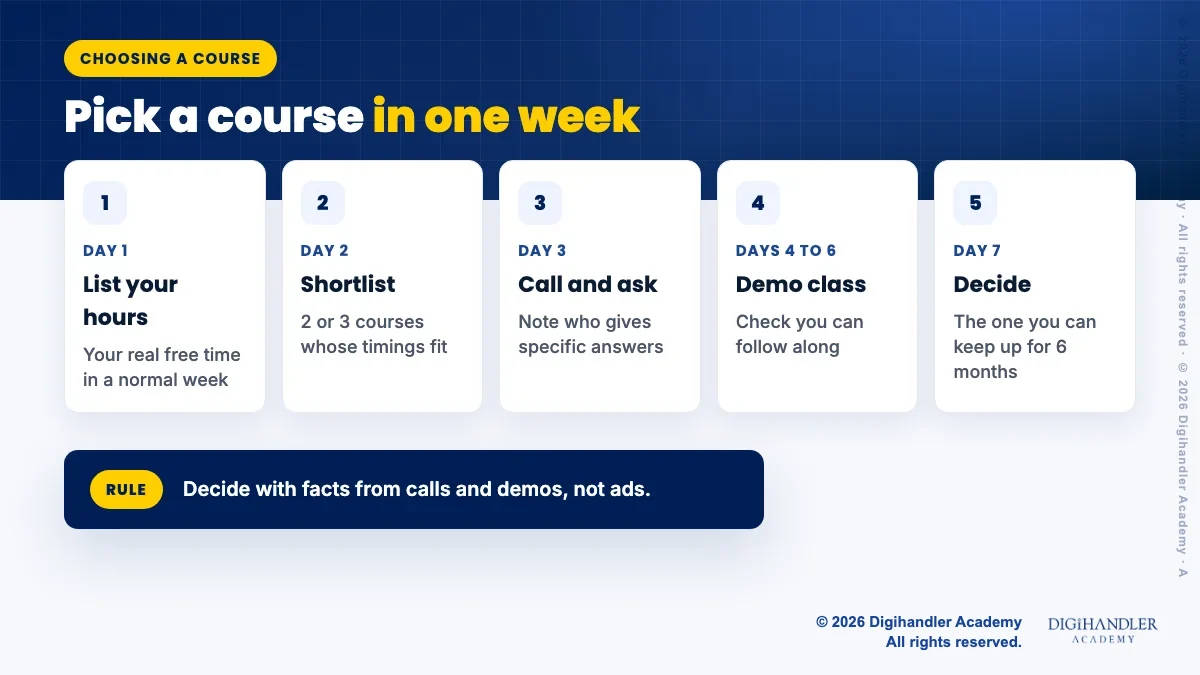
You do not need a month of research. Give it one focused week, and decide with facts instead of ads.

Riya writes Digihandler Academy's guides and roadmaps. Every article is fact-checked and reviewed by Lovish Madaan, founder & trainer, who has run the Digihandler agency since 2018. More from Riya →
Yes. Many working professionals learn digital marketing alongside a full-time job. The most common setup is a weekend batch with live classes on Saturday and Sunday, plus short practice sessions on two or three weekday evenings. Plan for about 8 to 10 hours a week in total. Choose a course that records its classes, so a late night at work does not leave you behind, and that gives you practical tasks on real accounts rather than only videos and quizzes.
About 8 to 10 hours a week is a realistic target for most part-time learners. Roughly half goes to live classes and the other half to practice and revision. With fewer than 6 hours, progress becomes slow because each class is spent recalling the previous one. With more than 12 hours, many working people burn out within a couple of months. Choose a number you can keep up for six months and protect it like any other appointment.
A weekend course can teach the same skills as a weekday one, because the content is usually the same and only the timing differs. What decides whether you get hired is your proof of work: a portfolio of real campaigns or content, a clear resume and practice explaining your results in interviews. No course can guarantee a job. Look for a weekend batch that includes real projects and interview preparation, and put in the practice hours between classes.
For most busy people, live classes with recordings as a backup work best. Recorded courses are flexible, but without a fixed class time it is easy to stop and nobody notices. Live classes give you a routine, a trainer who answers questions about your own work and classmates who keep you going. Recordings then cover the weeks you miss. A purely recorded course suits people who are already very self-disciplined or only want to learn one tool.
Ask whether classes are live or recorded, the exact batch days and times, and whether recordings are available for missed classes. Ask from which month you work on real ad accounts and websites, who the trainers are and how you can ask questions between classes. Ask what placement help includes, the full fee with instalments and refunds, and whether you can attend a free demo class first. Clear, specific answers are a good sign.
Where AI genuinely saves marketers time on real client work, and where it quietly makes things worse.
Read article →
What decides whether an AI assistant quotes your page, and the fixes worth doing first.
Read article →