3 Days Free Demo Class — sit in on real classes before you enrol.Book your free demo → 9991 729 730

Social Media Manager Job: What You Actually Do All Week

A social media manager job looks like posting pretty pictures from the outside. Inside, it is planning, writing, replying to people, reading numbers and explaining them to a boss or client. This guide walks through a normal week, the skills you need, free tools that work in India, and how to get started with a small portfolio.

Riya Malik 7 min read Updated November 2026
Social Media Manager Job: What You Actually Do All Week

What does a social media manager do?

A social media manager runs a brand's accounts so they bring real results: enquiries, footfall, sales or trust. Posting is only one part of it.

Think of a shopkeeper who also has to arrange the window display, talk to every customer at the counter and count the cash at night. The social media manager does all three for an online shop window.

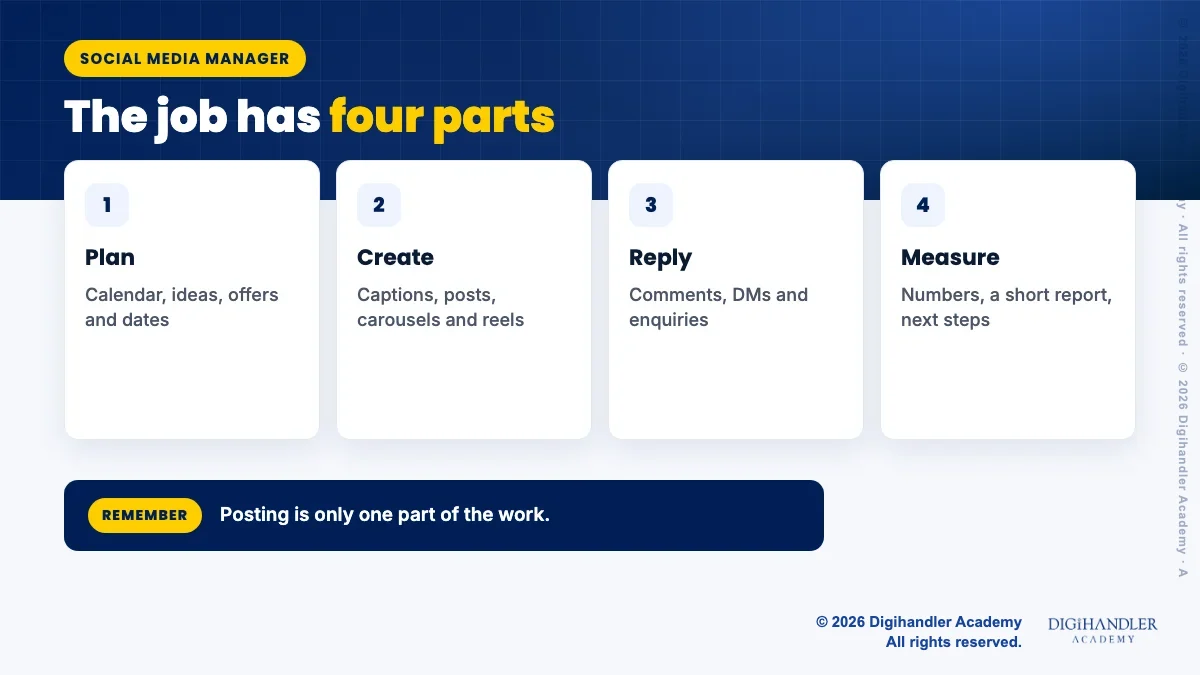
The work falls into four parts: plan what to post, create it, talk to the people who respond, and measure what worked. Small businesses expect one person to do all four. Bigger teams split them.

If you are moving into this from another field, our guide to a career switch into digital marketing shows which of your old skills already count.

Four parts of a social media manager job: plan, create, reply and measure, each with a short example task
Most of the job fits into four parts. Posting is only one of them.

A realistic week in the job

Here is a normal week for someone handling two or three small clients, say a coaching centre in Rohtak, a boutique in Jaipur and a café. Your exact days will differ, but the rhythm is similar.

  • Monday: plan.: Check last week's numbers, note what worked, and fix the content calendar for the week. Collect photos, offers and dates from each client.
  • Tuesday: create.: Write captions, design posts and carousels, and edit short videos. Batch work saves time: make three reels in one sitting, not one a day.
  • Wednesday: approvals and scheduling.: Send drafts to the client on WhatsApp or email, make changes, then schedule the approved posts.
  • Every day: replies.: Answer comments and DMs, pass enquiries to the sales person, hide spam, and flag angry messages to the owner quickly.
  • Thursday: shoot and engage.: Visit a client or guide them on a phone shoot. Spend time engaging with local accounts and partner pages.
  • Friday: report and call.: Fill a simple report and take a short call: what we posted, what people did, what we try next week.

What skills do you need to become a social media manager?

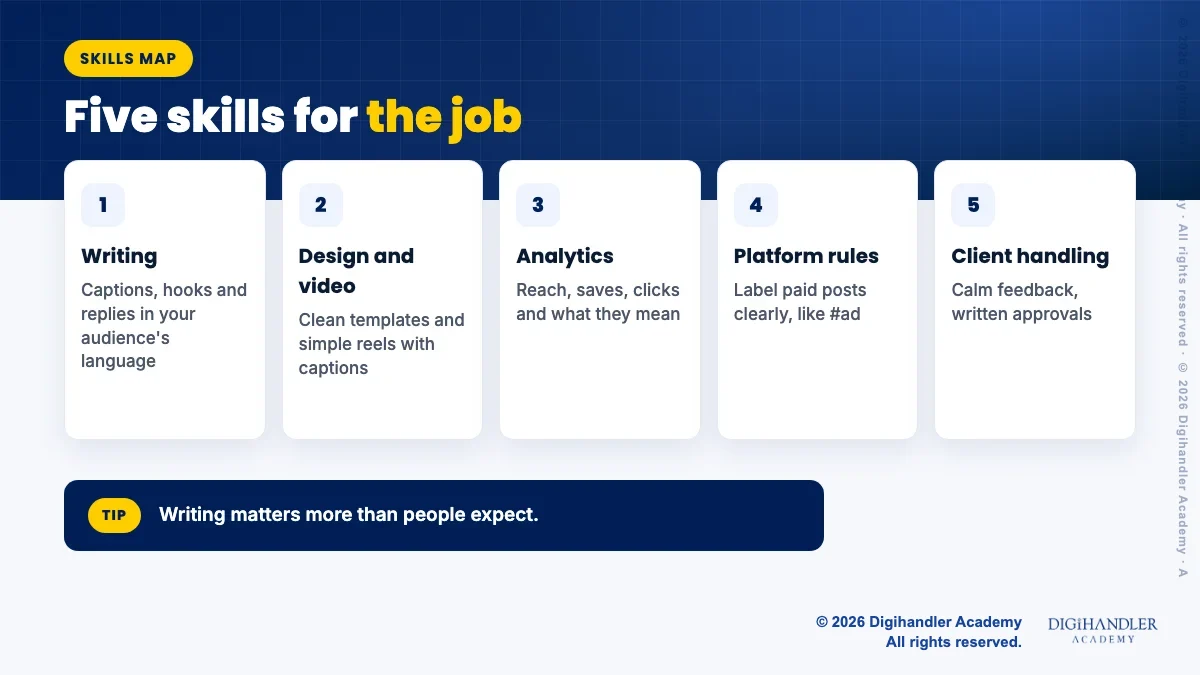
You do not need a design degree. You need five working skills, and each one can be practised for free.

  • Writing.: Clear captions, hooks and replies in the language your audience uses, often Hinglish. This is the most underrated skill in the job.
  • Basic design and video.: Clean posts from templates, readable text on images, and simple reels with captions. Our guide on editing reels people watch covers the video side.
  • Analytics.: Reading reach, saves, shares, profile visits and link clicks, and saying in one line what they mean for the business.
  • Platform rules.: Knowing what each platform allows. In India, paid or gifted posts by influencers should carry a clear label such as #ad, as the advertising body ASCI asks, and Instagram has its own paid partnership label for this.
  • Client handling.: Taking feedback calmly, saying no politely, and keeping a record of what was approved.
Skill map with five skills for a social media manager: writing, basic design and video, analytics, platform rules and client handling
Five skills cover most of the work. Writing matters more than people expect.

Which tools can you use for free in India?

Start with free tools. Pay for something only when a client's work needs it. All of these were available in India when we checked in November 2026, but free plans change, so check the limits on each tool's own page.

  • Canva (free plan).: Templates, photos and simple video editing. Canva's own pricing page shows social post scheduling is not part of the free plan, so schedule elsewhere.
  • Meta Business Suite.: Meta's own tool for creating and scheduling Facebook and Instagram posts and stories, replying to messages and seeing insights in one place.
  • Edits.: Instagram's own video editing app, listed free in the Indian App Store. A good replacement for CapCut, which is banned in India.
  • Buffer (free plan).: Useful for LinkedIn and other platforms. Its free plan allows up to 3 channels and 10 scheduled posts per channel at a time.
  • Google Sheets and Google Drive.: For the content calendar, the monthly report and sharing files with clients.
  • Native insights.: Instagram, Facebook, LinkedIn and YouTube all show their own numbers for business or creator accounts. Learn these before any paid analytics tool.

Agency, in-house or freelance: where should you start?

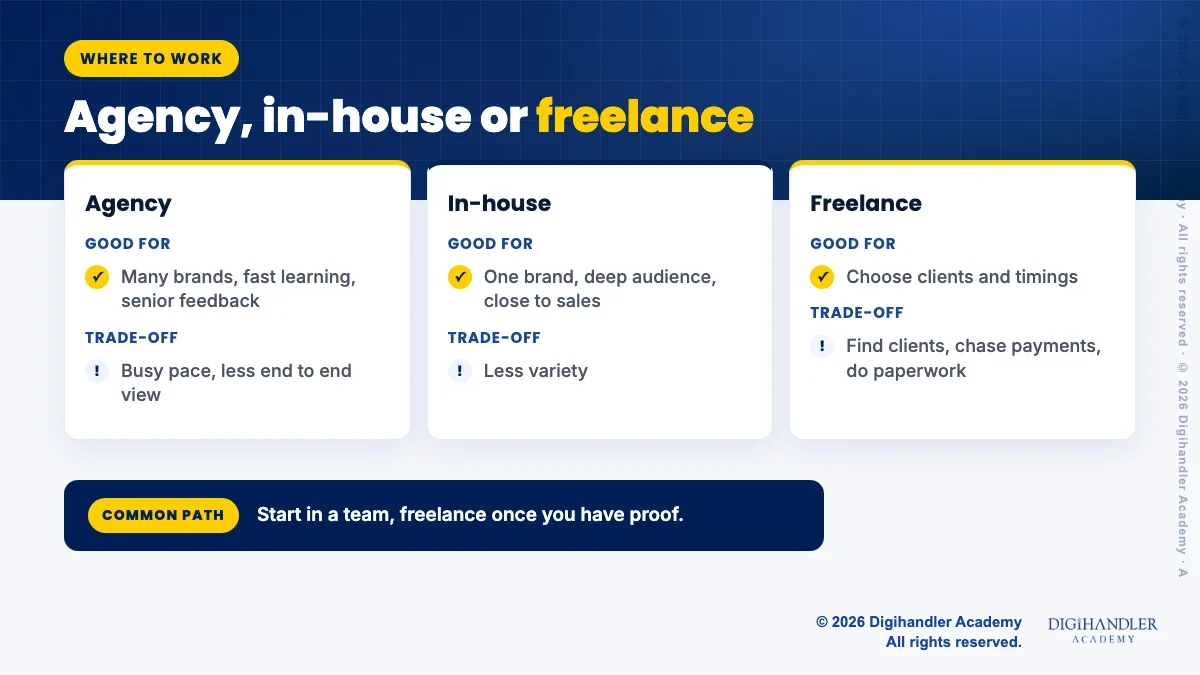
There are three common ways to do this work. None is better for everyone. Choose by how you like to learn.

  • Agency.: You handle many brands at once, learn fast and get feedback from seniors. The pace can be tiring and you may not see results end to end.
  • In-house.: You work for one brand, a school, a hospital, a D2C brand. You go deep on one audience and work closely with sales. Variety is lower.
  • Freelance.: You choose clients and timings, but you also find clients, chase payments and handle tax and paperwork yourself.
Comparison of agency, in-house and freelance social media work, showing what each is good for and its main trade-off
Many people start in an agency or in-house, then freelance once they have proof.

How do you build a small portfolio with no clients?

A client does not need fifty samples. They need proof that you can plan, create and report. Three small projects are enough to start.

First, run your own practice account on one niche for 30 days. Second, help one real local business for free or at a small fee, with their permission to show the work. Third, make a one-page monthly report for that business, even if the numbers are small.

Honest small numbers beat big made-up ones. Show what you posted, what changed and what you would do next. Our 30-day portfolio plan gives a day-by-day version, and the 30-day Instagram plan for a local business is a ready practice brief.

How to become a social media manager: landing the first client or job

Search for these job titles on Naukri, LinkedIn and Internshala: Social Media Executive, Social Media Associate, Community Manager and Content and Social Media Intern. The first title is often more junior than the word manager suggests, and that is fine.

For freelance work, start close to home. Local businesses already know you, and you can see their problem in person.

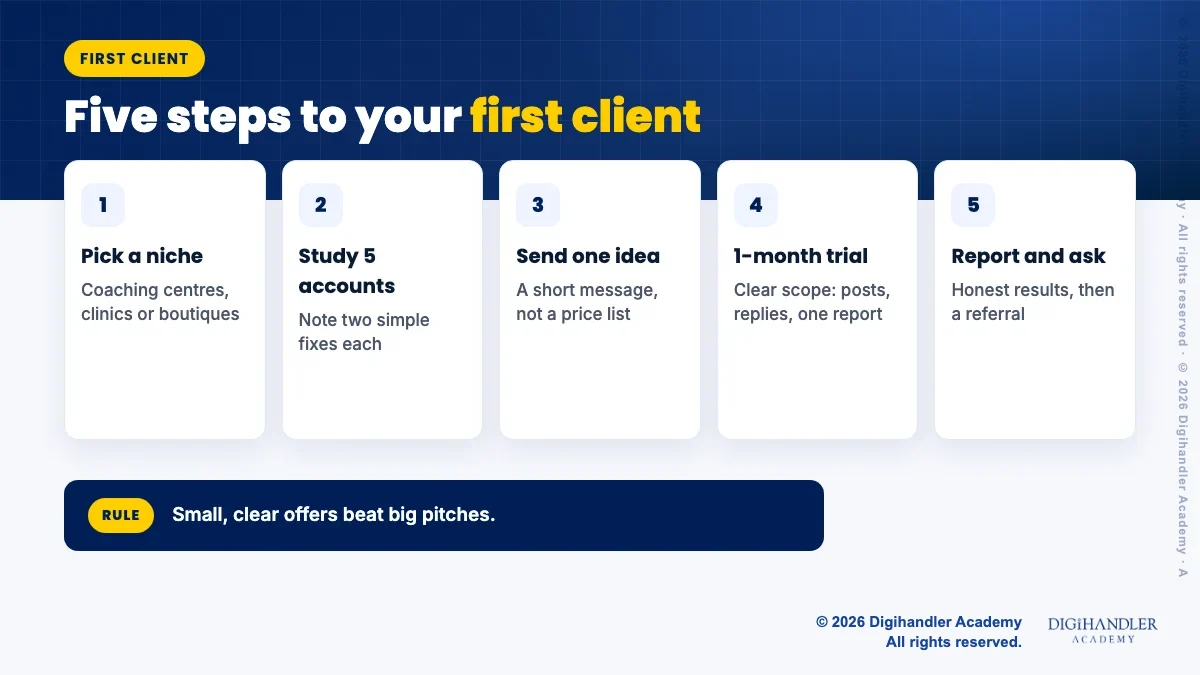
  1. Pick one niche you understand, such as coaching centres, clinics or boutiques.
  2. Study five local accounts in that niche and note two simple fixes for each.
  3. Send a short message with one free idea, not a long pitch or a price list.
  4. Offer a small paid trial for one month with a clear scope: number of posts, replies, one report.
  5. Report honestly at the end of the month and ask for a referral if they are happy.
Five steps to a first social media client: pick a niche, study local accounts, send one free idea, offer a one-month trial, report and ask for a referral
Small, clear offers win first clients more often than big pitches.

Mistakes that beginners make

Most early problems come from habits, not lack of talent. Watch for these six.

  • Chasing followers only.: A boutique needs DMs and store visits. Report the numbers that pay the bills.
  • No written scope.: Without a list of what is included, one client turns into unlimited work. Put it in writing, even on WhatsApp.
  • Slow replies.: An enquiry answered the next day is often a lost customer. Set fixed times to check messages.
  • Copying trends without a reason.: A trend is useful only if it fits the brand and the buyer.
  • Ignoring the ads side.: Many clients will ask you to boost posts. Learn the basics of performance marketing so you can talk about cost per lead with confidence.
  • Promising results.: Promise effort, process and honest reports, never a follower count or a sales number.

Your first week as a learner: a simple plan

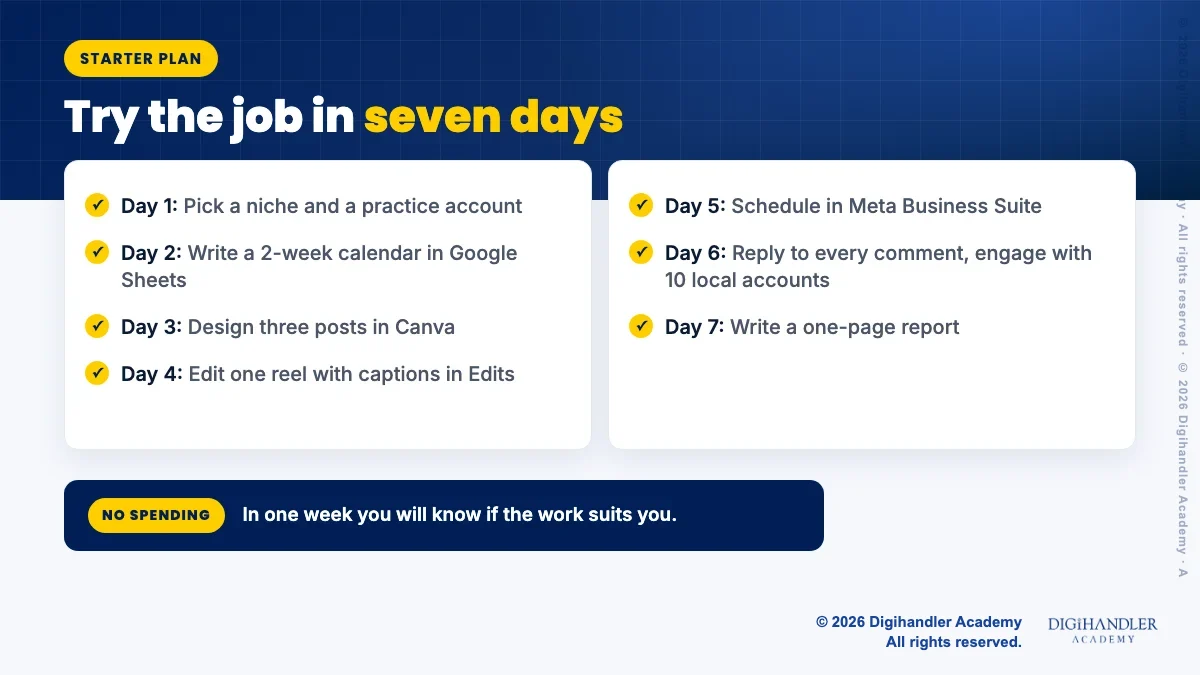
You can test whether this job suits you in seven days, with no spending.

If you would like to try it with a trainer watching, a free demo class at the academy is one way. Self-study works too; the social media marketing course page lists the topics in order, which you can use as a checklist either way.

  1. Day 1: pick a niche and a practice account.
  2. Day 2: write a 2-week content calendar in Google Sheets.
  3. Day 3: design three posts in Canva.
  4. Day 4: edit one reel with captions in Edits.
  5. Day 5: schedule everything in Meta Business Suite.
  6. Day 6: reply to every comment and engage with ten local accounts.
  7. Day 7: write a one-page report: what you posted, what happened, what you try next.
Seven-day starter plan checklist for trying social media management: niche, calendar, three posts, one reel, scheduling, replies and a one-page report
One week, no spending, and you will know if the work suits you.
Riya Malik
Written by Riya MalikContent Writer, Digihandler Academy

Riya writes Digihandler Academy's guides and roadmaps. Every article is fact-checked and reviewed by Lovish Madaan, founder & trainer, who has run the Digihandler agency since 2018. More from Riya →

Digital marketing skills, explained

  1. Part 1: Switching careers into digital marketing
  2. Part 2: What performance marketing is
  3. Part 3: What a social media manager does (you are here)
  4. Part 4: GA4 for beginners coming soon
  5. Part 5: Editing reels that get watched coming soon
  6. Part 6: Learning part-time while you work or study coming soon

From our Instagram

Learn viral content creation · View on Instagram
What every Digihandler Academy student gets (swipe) · View on Instagram

Common questions

A social media manager plans posts, writes captions, designs or edits simple content, schedules it, and replies to comments and messages. They also read the numbers on each platform and explain them to the boss or client in a short report. On most days, replying to people and fixing small problems takes more time than making new posts. In small businesses one person does all of this, while bigger companies split the work between writers, designers and community managers.

Yes, but the first role is usually called Social Media Executive, Associate, Intern or Community Manager rather than Manager. Freshers get hired when they can show work, not only a certificate. A practice account run for a month, one real local business you helped, and a one-page report of results make a strong start. Search on Naukri, LinkedIn and Internshala, and apply to agencies as well as in-house roles at schools, clinics and D2C brands.

No. You need basic design sense, not a design degree. Most social media managers use templates in Canva, keep text short and readable, and stay consistent with a brand's colours and fonts. You should also be able to edit a simple reel with captions. Bigger brands often have a designer, and your job is to brief them clearly. Writing, planning and reading analytics usually matter more than advanced design skills in the first year.

Start with Canva's free plan for design, Meta Business Suite for scheduling Facebook and Instagram posts and replying to messages, and Instagram's Edits app for reels. Buffer's free plan covers up to 3 channels, useful for LinkedIn. Use Google Sheets for your content calendar and reports. CapCut is banned in India, so do not build your workflow around it. Free plans change, so check each tool's current limits on its own website before you rely on it.

For most beginners a job at an agency or a brand is the easier start. You get steady work, feedback from seniors and a chance to learn many accounts quickly. Freelancing gives you freedom, but you must find clients, write the scope, chase payments and handle paperwork yourself. Many people work in a job for some time, build proof of results, then take freelance clients on the side before going fully independent.

More from the blog

AI in digital marketing: what actually works right now

AI in digital marketing: what actually works right now

Where AI genuinely saves marketers time on real client work, and where it quietly makes things worse.

Read article →

AI SEO: how to get cited inside AI search results

AI SEO: how to get cited inside AI search results

What decides whether an AI assistant quotes your page, and the fixes worth doing first.

Read article →

Learn this properly

3 days free · Rohtak campus & live online

We'll call you within 24 hours. No spam, ever.

Prefer to talk? Call 9991 729 730.