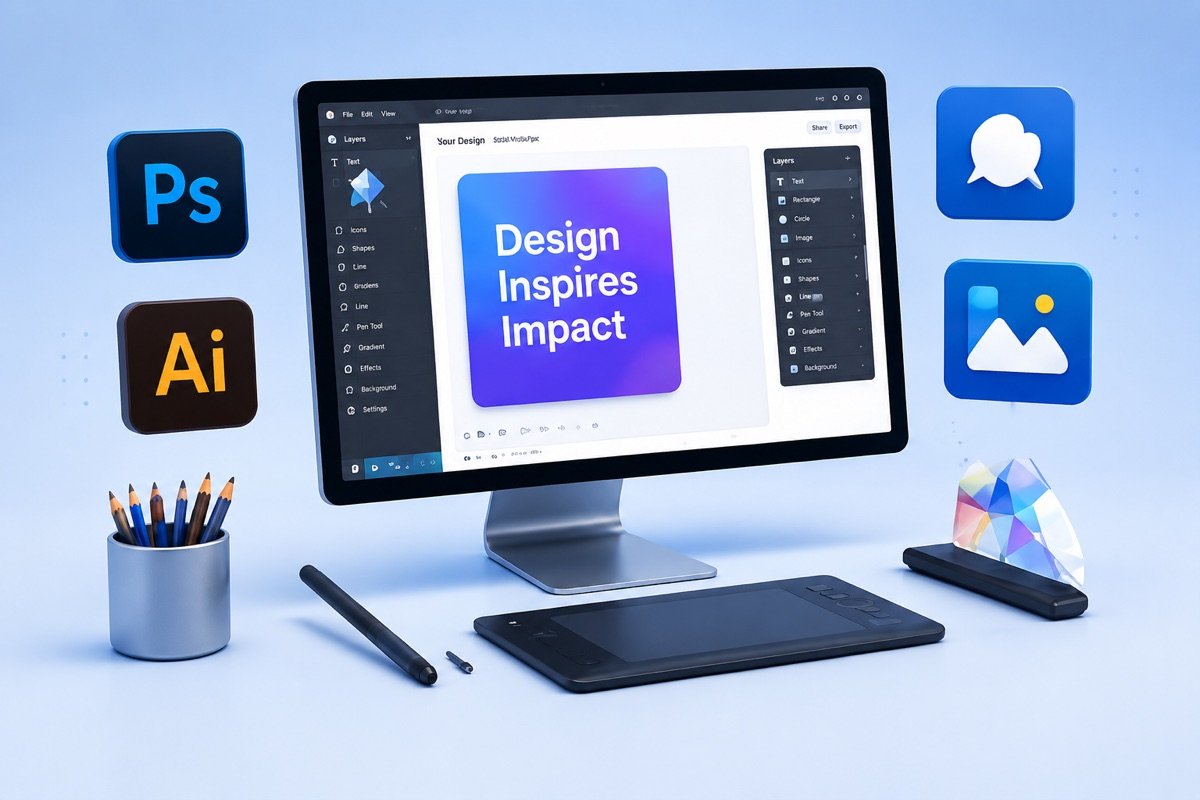
Use AI images for concepts, backgrounds, pattern and abstract creative, and for variant testing where the subject is generic. Do not use them for your premises, your team, your products or your results — those need real photographs, and passing off a generated image as a real one is the fastest way to lose a customer who visits.
The tools worth having open
- Canva AI — Fastest route from idea to a sized ad creative, because generation sits next to the layout tools. Where most of our students start.Free tierTaught in our course
- Ideogram — Handles text inside an image better than most, which matters for offer creatives where the words are the point.Taught in our course
- Gemini image generation — Strong at editing an existing image rather than starting from nothing — useful for background swaps on product shots.Free tierTaught in our course
- Stock photography — Still the correct answer more often than people admit. A real photo of a real thing beats a generated approximation.
The workflow that produces usable creative
Start from the offer, not the image. Write the line the ad has to carry, then generate the visual that supports it. Working the other way round produces pretty images that sell nothing.
Generate wide, cut hard. Six variants, keep one. The value is in having options to test, not in the first output being good.
Then put it in the real layout at the real size before judging it. An image that looks striking full-screen often collapses at 320 pixels wide in a feed, which is where it will actually be seen.
Where it still falls over
- Hands, text, logos — improving, still the giveaway. Check every output at full size before it goes near a client.
- Your actual premises — never generate these. A prospective student who visits and finds a different building has learned something about you.
- Faces of real people — do not generate a likeness of anyone who has not agreed to it.
- Results and screenshots — a fabricated dashboard is a fabricated claim, whatever tool drew it.
Labelling, and why it is not optional
Meta requires advertisers to disclose AI-generated or digitally altered content in ads about social issues, elections and politics, and applies its own labels elsewhere. Google Ads has comparable political-content rules. Beyond platform policy, India's consumer protection rules on misleading advertising apply to a generated image exactly as they apply to a photograph.
The practical rule we teach: if a reasonable person would assume the image is a photograph of something real, either use a photograph or label it. That single test keeps you clear of most trouble.